
The Cubic Zirconia of Literature?
As somebody who has always enjoyed poetry – both reading and writing – I have become fascinated with the new, rising trend of self-expressing, self-publishing, self-confident Instagram poets. After learning about the rising popularity of spoken word artists, such as Rupi Kaur, who use Instagram as a platform to share their poetry, I decided to set up my own Instagram poetry page. I soon found that there were countless aspiring poets on Instagram, all hungry for virtual ‘likes’, ‘followers’ and fame. Unlike the diamonds of the past, these poets are quickly formed and easily accessible – the Argos engagement rings of poetry, the rhinestones of creative writing.
No longer, it seems, is Instagram merely a place for hipsters to share their smug, breakfast selfies (with crafted coffees and filtered faces!) or a shameless marketplace for Kardashian wannabes to sell images of their bodies alongside weight-loss pills or laxative teas.

Now, Instagram has bred a batch of fresh wordsmiths. With trail-blazers like Atticus and Rupi Kaur, who have earnt fame and adoration (as well as the obvious financial benefits) so it is easy to see the appeal for these aspiring artists. Instagram is a platform for thousands of budding poets to express themselves to the masses freely – and for free! With free-ness comes freedom. Poetry is no longer an elitist art form, reserved for the enjoyment of the higher classes, a hobby for the older generation or even a guilty pleasure of heartbroken nerds. Some journalists have claimed that social media has ‘turned an art form into an industry’ as though, until now, ‘Poet’ could never have been a job title. Liberation! Poetry is now anyone’s skill. It can be celebrated instantly, no matter the quality. Learning and persevering is the way of the past. Why should writing be a skillset kept hidden behind the lock and key of education and perspiration?
I admire and respect Rupi Kaur’s passion, drive and performance skills. Her heart is clearly and often quite beautifully woven into her words, which she presents delicately in her writing and hypnotically through her voice. Here is a taste of her milk and honey:
While Rupi Kaur is arguably the most successful of the new generation of Instagram poets, with 3.5 million followers, she is not the only success story. Atticus Poetry is another example, with 1 million followers, a New York Times bestseller and now his own brand of wine, Byronically named ‘Lost Poet’. Personally, I would describe his style as romantic, smooth and easy, like brie – probably tastes better with a bottle of that wine.
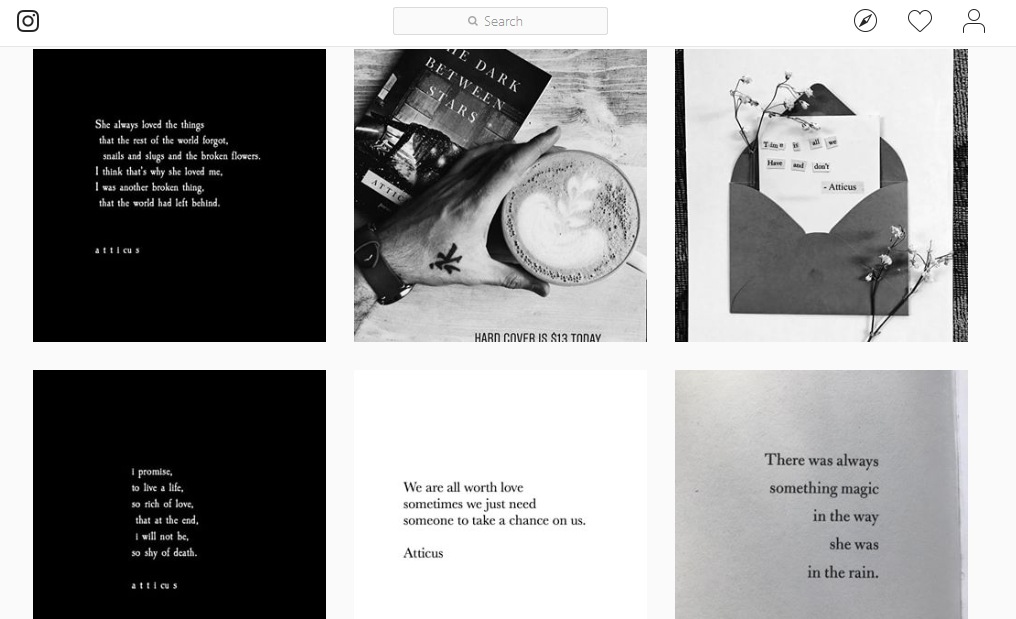
Of course, in many ways, it does not matter who the writer is. A good reader would be able to sniff out as much meaning from a love-sick teenager’s drivel than from a Shakespearean masterpiece. However, this reader’s experience of such explicit poetry is unlikely to ever come close to the enjoyment of the subtle word-play in a canonical sonnet or the thrilling frustration of an ambiguous final verse, which leaves you scratching your head and questioning everything.
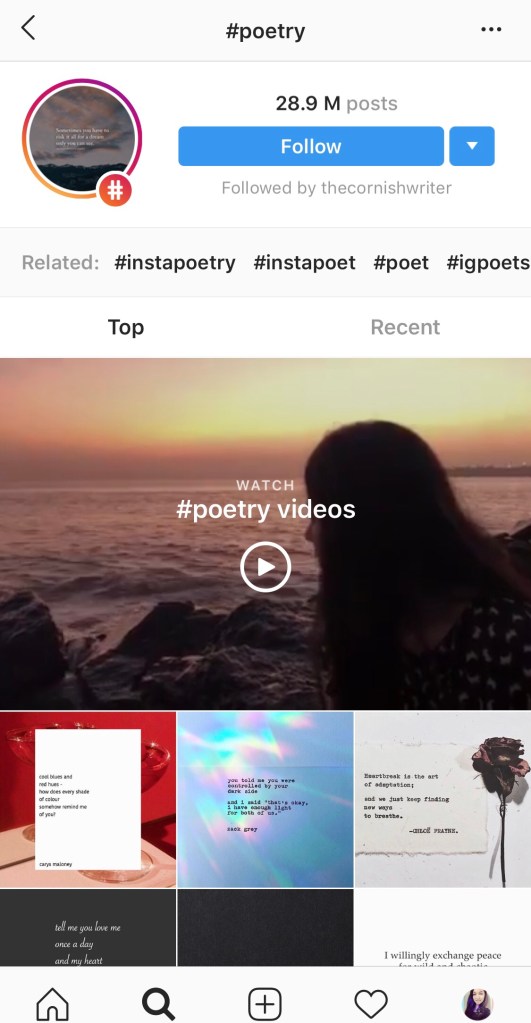
Successful and accessible Instagram poets, like Atticus, have seemingly inspired a hoard of hopefuls. The hashtag #poetry alone finds 28.9 million results.
Sifting through the mud to find nuggets of gold is becoming increasingly difficult in the already over-saturated, dirty, stream of online Instagram poets. Time has a way of preserving the worthy. Diamonds were formed maybe 3 billion years ago. We cherish their precious qualities along with their rarity. Perhaps in the future, Instagram filters will not be applied to create the illusion of flawless skin on models, or enhancing the already vibrant colours of a naturally beautiful landscape, but to sieve through the sand of Instagram poetry and unearth the gems within.
 Technology, Poetry & Me